

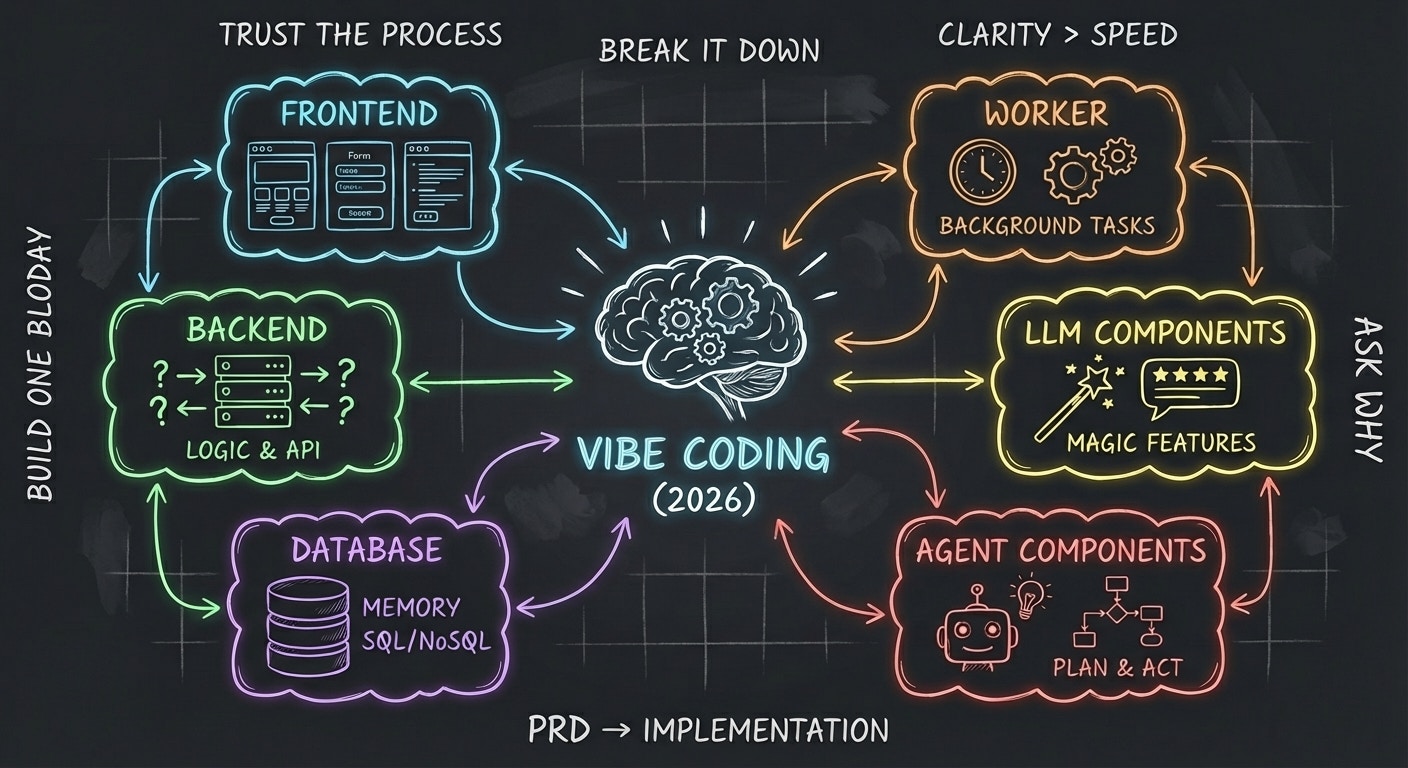
Do not get overwhelmed by the complexity of any existing similar software. Any complicated system can be broken down into smaller parts. We need to just execute those smaller parts perfectly while keeping the context of the larger picture. Trust the process.In 2026, any typical software has a set of distinct parts to it
- Frontend
- Backend
- Database
- Worker
- LLM Components
- Agent Components
1. Frontend - What users see and interact with
This is the visual layer of your product - Buttons, Screens, Forms, Animations, Text, images, layouts etc. Good news: This is the easiest and most fun part to build today.How to approach it
- Don’t overthink concepts like HTML, CSS, React, etc.
- Start building.
- Read the design or planning doc.
- Implement screen by screen.
2. Backend - The brain behind the app
The backend is where logic lives. It answers questions like:- What happens when a user clicks “Submit”?
- Where does the data go?
- Who is allowed to do what?
What the backend actually does
- Receives requests from the frontend
- Validates data
- Talks to the database
- Sends responses back
What you should focus on
- What is an API?
- How does one request turn into one response?
- How to debug when something fails
3. Database
The memory of your app. A database is where your app remembers things.- Users
- Messages
- Orders
- Files
- Settings
Two simple choices
- NoSQL → flexible, fast to start, fewer rules
- SQL → structured, reliable, industry standard
- Just learn basics like: Tables, Rows, Columns, Primary keys
4. Workers - Things that should happen in the background
Not everything should run instantly. Some tasks like Sending emails, sending notifications, processing files, running scheduled jobs, responding to events, That’s where workers come in.Why workers exist
- They prevent your app from feeling slow
- They run tasks later or repeatedly
- They make systems reliable at scale
- “Send this email after 5 minutes”
- “Check this condition every hour”
- “Process this video in the background”
5. LLM Components - AI features that feel magical
LLMs give your app superpowers. They can: Rewrite text, summarize documents, answer questions, generate images, analyze content These are usually:- External APIs
- Models you call when needed
- Pay-per-use tools
Important mindset
- LLMs are tools, not your entire app
- Use them where they add real value
- Keep inputs and outputs clear
6. Agent Components - AI that can plan, decide, and act.
Agents are LLMs with memory, tools, and goals. Instead of:“Do this one thing”You get:
“Figure out what needs to be done and do it”
What agents can do
- Break problems into steps
- Call APIs
- Use tools
- Remember context
- Take actions based on conditions
- Autonomous
- Proactive
- Less manual
The Big Picture (Important)
You don’t build everything at once. Most apps evolve like this:- Frontend + Backend
- Add Database
- Add Workers
- Add LLM features
- Add Agents if needed
Some small habits that have kept me on top of things while building apps
- You should have a habit of understanding what is what. To build this, whatever you feel is not clear in your head, ask the Copilot tool you are using. Make sure that tool has access to your codebase. Don’t ask ChatGPT. It does not have your project’s context. But cursor/Claude-Code/Copilot - basically where you are working, you should ask that agent.
- Ask a lot of whys to the agent.
- Create a habit of creating PRDs -> Technical Implementation Doc and then implement the code using agent mode. Yes, you will burn extra tokens, but this helps you understand the systems and will improve the skill of writing better prompts.
- Be religious about reading the PRDs, Summaries and tech docs.
You don’t need to learn everything, no need to get the perfect stack and most importantly no excuse to wait. Pick one idea. Break it into blocks. Build one block today.This is the best time in history to be a builder. And if you’re reading this - you already are one. Cheers!